
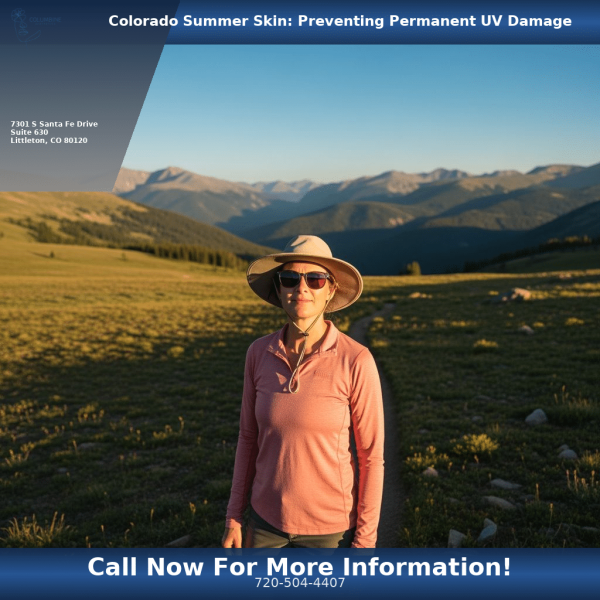
Colorado Summer Skin: What Your Littleton Medspa Wants You to Know Before UV Damage Becomes Permanent
Key Takeaways:
- Colorado’s elevation delivers significantly more UV radiation than at sea level, making summer the highest-risk season for melanocyte damage, collagen breakdown, and hyperpigmentation accumulation — even on overcast days.
- Several aesthetic treatments remain safe and effective during peak summer months, while others require careful timing around sun exposure to protect results and skin integrity.
- If you’ve accumulated UV damage this summer, early fall is the ideal window to begin active repair with peels, microneedling, and medical-grade skincare before pigmentation becomes permanent.
Colorado summers are genuinely extraordinary — and genuinely hard on your skin. The most practical thing you can do right now is understand what’s actually happening at 5,400 feet of elevation, make smart decisions about which treatments to continue or pause, and put a repair plan in place before this season’s UV exposure becomes next decade’s permanent pigmentation. That’s exactly what summer skin care Colorado medspa planning looks like when it’s done well.
Why Colorado Summer UV Exposure Is a Different Category of Risk
Most sun protection advice was written for sea-level conditions. Colorado doesn’t operate at sea level.
According to the EPA, UV radiation increases by approximately 8–10% for every 1,000 feet of elevation gained. At Littleton and the broader Denver metro — sitting at roughly 5,400 feet — that means you’re receiving meaningfully more UV than someone spending the same amount of time outdoors in Miami, Houston, or New York. Add Colorado’s characteristically low humidity (which means fewer atmospheric particles to scatter UV), its high proportion of clear-sky days in June and July, the reflective intensity of hiking near snowfields or open water, and the cumulative exposure most Colorado residents absorb each summer, and the cumulative exposure is substantial.
What that exposure actually does to skin is worth understanding clearly.
UV radiation, specifically UVA, penetrates deeply into the dermis and activates melanocytes — the pigment-producing cells responsible for both your tan and the dark spots that outlast it. Repeated activation causes melanocytes to overproduce and cluster irregularly, leading to the development of solar lentigines (sunspots) and diffuse hyperpigmentation over time. UVB, meanwhile, causes direct DNA damage in skin cells and is the primary driver of acute sunburns — each of which measurably accelerates photoaging.
Collagen degradation compounds the picture. UV exposure triggers matrix metalloproteinases (MMPs), enzymes that break down the collagen and elastin scaffold responsible for skin firmness and texture. In 2026, the research on this mechanism is unambiguous: sustained UV exposure in Colorado’s high-altitude summers accelerates the structural changes most patients associate with skin aging — loss of firmness, deeper lines, and rougher texture — faster than the same exposure would at lower elevations.
The point isn’t to stay indoors. That’s not who Colorado residents are, and it’s not realistic guidance. The point is to understand what you’re working with so you can make informed decisions about protection, timing, and repair.
Treatment Timing: What’s Safe Now vs. What Deserves Patience
One of the most common questions at summer consultations is which treatments to continue and which to pause. The answer depends on how much time you spend in the sun and what kind of recovery each treatment requires.
Several treatments at Columbine remain straightforward choices during the summer months:
- Xeomin and Daxxify (neuromodulators) are unaffected by sun exposure and require no sun avoidance before or after treatment. Summer is an excellent time for maintenance appointments.
- Hyperdilute Radiesse for skin quality and gradual collagen stimulation carries no meaningful sun-sensitivity concern. Results build gradually, and treatment timing is flexible.
- Microneedling with AnteAGE serum can continue in summer with a clear protocol: avoid active sunburn, commit to medical-grade SPF 30+ immediately post-treatment, and keep treated skin out of direct sun for the first 24–48 hours. The growth factors in AnteAGE support the skin’s repair response directly — a meaningful benefit during a season when skin is already managing UV stress.
Chemical peels require more deliberate timing. Lighter superficial peels (including certain PCA Skin formulations) can be appropriate in summer, particularly for patients who are disciplined about sun avoidance in the week following treatment. Deeper or more active peel formulations, however, are best planned for fall or early spring — post-peel skin is more photosensitive, and the gap between treatment and aggressive sun exposure should be wide enough to protect the result and the skin barrier. If you’re hiking the Colorado Trail every weekend in July, that’s worth discussing at your consultation before booking a peel.
Active Damage Already Showing? Here’s What Can Be Done
If you’re noticing more pigmentation, uneven tone, or textural changes than you expected heading into or through this summer, you’re not alone — and you’re not out of options.
Early pigmentation is precisely the right time to intervene. Once melanocytes have been repeatedly stimulated and pigment deposits have organized into well-established solar lentigines, they’re significantly harder to address. Catching the change when it’s still relatively recent gives treatments better targets.
PCA Skin Peels address UV-triggered hyperpigmentation through a combination of chemical exfoliation and melanin-disrupting ingredients. Depending on the formulation selected during your consultation, a peel series can meaningfully reduce the appearance of early sunspots and even skin tone — particularly when the skin isn’t being re-exposed to heavy UV between sessions. This is why fall becomes the ideal treatment window: the intensity of Colorado’s UV season has passed, sun exposure decreases naturally, and the skin can respond to treatment without competing inputs.
AnteAGE microneedling addresses the textural and structural dimensions of UV damage. Microneedling creates controlled micro-injuries that trigger the skin’s wound-healing cascade, and the AnteAGE growth factor serum delivered during treatment accelerates and supports that response at the cellular level. For patients dealing with both pigmentation and early texture changes from summer UV exposure, combining a peel series with an AnteAGE microneedling protocol in the fall creates a comprehensive approach to repair.
Why Alastin TriHex Technology Fits This Moment
Alastin Skincare’s TriHex Technology was developed specifically to support skin in active remodeling. The mechanism targets the clearance of damaged elastin and collagen fragments — the debris left behind by UV-triggered MMP activity — while simultaneously supporting the synthesis of new collagen and elastin.
For Colorado residents who have finished a summer of significant UV exposure, this is exactly the kind of support their skin needs. Used as part of a fall skincare protocol, Alastin products help prepare skin for treatment, enhance treatment outcomes, and sustain results between sessions. It’s not a standalone solution, but it is a meaningful part of how Columbine approaches post-summer skin repair.
What Columbine Recommends for Daily Summer Protection Right Now
The foundation of summer skin management in Colorado isn’t complicated, but it does require consistency:
- Medical-grade SPF 30+ is applied every morning and reapplied every two hours during outdoor activity. SPF 50 or higher for high-altitude or water-adjacent activities.
- An antioxidant serum — specifically one containing Vitamin C, Vitamin E, or ferulic acid — applied under SPF to neutralize free radicals generated by UV exposure before they trigger downstream damage.
- Avoiding peak UV hours between 10 a.m. and 3 p.m. when practical, recognizing that Colorado residents on the trail at 7 a.m. are already getting meaningful UV.
At a summer consultation with Columbine, Allison assesses what’s actually happening with your skin right now — not just what you’re concerned about cosmetically, but what patterns of UV response are developing that deserve attention before fall. Early intervention consistently produces better outcomes than waiting until damage is well established.
If this summer’s outdoor season has left you with more pigmentation, redness, or textural change than you expected, that’s useful information — and it’s the right time to act on it.
Sources
1. UV Index and elevation-related UV increase — U.S. Environmental Protection Agency (EPA): https://www.epa.gov/sunsafety/uv-index-scale-0
2. UV radiation and photoaging mechanisms (collagen degradation, MMPs, melanocyte activation) — National Institutes of Health / PubMed: https://www.ncbi.nlm.nih.gov/pmc/articles/PMC3583891/
3. Solar UV radiation and skin cancer risk — World Health Organization: https://www.who.int/news-room/fact-sheets/detail/ultraviolet-radiation
Frequently Asked Questions
Why Trust Columbine Aesthetics
At Columbine Aesthetics, we believe your aesthetic journey should be as unique as you are. Led by Allison Page, NP-C, our highly skilled Nurse Practitioner with over 20 years of healthcare experience, we combine medical expertise with an artistic eye to deliver natural, beautiful results that enhance — not alter — your appearance.
We specialize in helping clients make informed, confident decisions about treatments such as Dysport® and Botox®. While both smooth fine lines and soften wrinkles, they work in slightly different ways:
- Dysport® offers a quick onset and diffuses more easily across larger treatment areas, making it ideal for broader expression lines.
- Botox® provides exceptional precision, perfect for targeted wrinkle reduction and refined definition.
During your consultation, we’ll take the time to understand your unique goals, explain the subtle differences between options, and design a treatment plan that’s tailored to your desired outcome. Our mission is to ensure you feel comfortable, informed, and excited about your results from start to finish.
In addition to neuromodulators, our comprehensive medical spa menu includes:
- Botox® and Xeomin® injections for wrinkle prevention and correction
- Dermal fillers with hyaluronic acid for restoring youthful volume
- PCA Skin® chemical peels to smooth texture and brighten skin tone
- Microneedling with AnteAGE® growth factors for powerful collagen stimulation
Every treatment is performed with precision and care, ensuring you achieve a refreshed, natural look — never “overdone.”
Serving Littleton, Denver, and surrounding Colorado communities, Columbine Aesthetics is recognized for its client-first approach, rigorous safety standards, and dedication to ongoing education in the latest aesthetic techniques. Whether you want to prevent early signs of aging, rejuvenate your skin, or enjoy a comprehensive facial enhancement plan, our warm and professional environment makes your journey enjoyable and rewarding.
Ready to look and feel your best? Contact Columbine Aesthetics Botox and Medspa in Littleton, CO, today to schedule your personalized consultation and discover why clients trust us for expertise, artistry, and exceptional care.


