Jawline Contouring in Littleton: How a Nurse Practitioner Chooses Between HA Filler and Hyperdilute Radiesse
Key Takeaways:
- Jawline filler uses hyaluronic acid to rebuild structural volume and sharpen definition, while Hyperdilute Radiesse works as a biostimulator to tighten loose skin and stimulate collagen along the jaw.
- The right treatment depends on what the face actually needs — volume loss calls for HA filler, skin laxity and jowl formation call for Hyperdilute Radiesse, and many patients in their 40s and 50s benefit from a staged combination of both.
- A thorough in-person assessment with Allison Page, NP-C, at Columbine Aesthetics determines which approach — or which sequence — fits your anatomy, so results look defined without looking overdone.
HA dermal filler rebuilds lost volume and re-establishes structural definition along the jaw. Hyperdilute Radiesse addresses something different: declining skin quality, early laxity, and jowl formation driven by collagen loss rather than volume deficit. Both treatments target the jawline, but they solve two genuinely different problems — and choosing the wrong one produces results that look off, even if the product is placed perfectly.
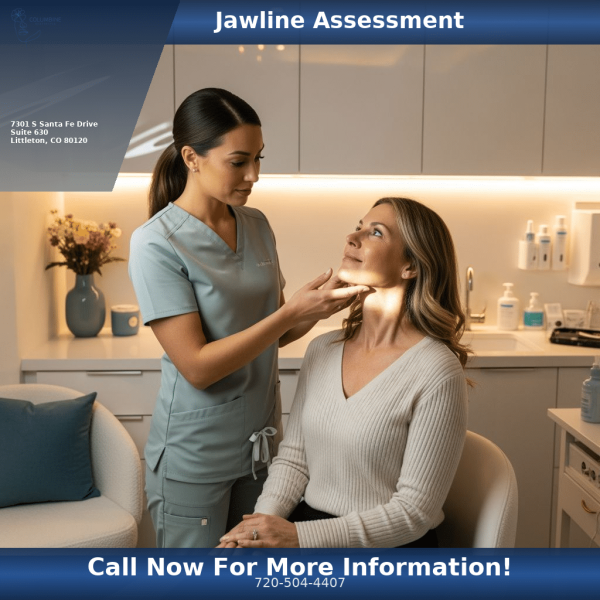
At Columbine Aesthetics in Littleton, the first question Allison Page, NP-C, asks is not “which product do you want?” It is “What is this jaw actually missing?” That distinction drives every jawline contouring decision made in the treatment room.
What a Strong Jawline Actually Requires
The jaw is not one structure — it is a layered system. The mandible provides the bony scaffold. Fat compartments above and below it contribute to the soft-tissue silhouette. The skin, with its collagen and elastin network, holds everything against gravity. Ligaments anchor soft tissue to bone at key points, including along the jawline itself.
Aging affects each layer on a different timeline. Bone resorbs gradually, particularly at the chin and jaw angles. Fat compartments deflate and shift, so the crisp lower-face border softens. Collagen production declines roughly 1% per year after age 20, according to published dermatology literature on skin aging, which means the skin loses its ability to spring back and begins to drape rather than define. Ligament laxity allows tissue to descend toward the jowl zone.
Some patients lose definition primarily from fat compartment deflation. Others lose it because the skin has stopped providing structural support. Many experience both. Identifying which mechanism is dominant — or whether both are present — determines the treatment plan.
When Is HA Dermal Filler the Right Jawline Treatment
HA filler is the correct choice when the underlying problem is structural volume loss. You can usually identify this pattern by looking at the angle of the jaw from below: the border looks blunted, soft, or lacking projection rather than sagging downward. The skin quality is still reasonably good — it moves with the face, snaps back when pinched, and doesn’t show much crepe texture.
Injecting a firm, lifting-grade HA filler along the mandibular border rebuilds the scaffold that fat compartment loss has eroded. The product is placed along the bone, not into soft tissue, which creates a clean edge without adding puffiness to the lower face. Results are visible within the first day or two as swelling resolves, and at the two-week mark, most patients see a sharper profile and a more distinct separation between the jawline and neck.
Jawline contouring in Littleton, CO, often follows seeing this result on social media — which is useful — but social media rarely shows the anatomy assessment that made that result possible. The filler itself does not create definition; placing it in the right location on the right anatomy does. An HA filler placed on a jaw that needs laxity correction will not hold well and may exaggerate soft tissue descent rather than correct it.
When Hyperdilute Radiesse Is the Right Choice
Hyperdilute Radiesse — calcium hydroxylapatite diluted with saline and lidocaine — behaves as a biostimulator rather than a filler. Injected in a highly diluted suspension, it spreads across a wide area and triggers the body’s own fibroblasts to produce new collagen and elastin. It adds minimal immediate volume; the result builds over 8 to 12 weeks as tissue quality improves.
This makes it the appropriate treatment when the jaw problem is laxity-driven. The clinical signs are skin that moves more than the bone beneath it, early jowl formation where soft tissue has descended below the mandibular border, and a jaw edge that looks soft because the skin is no longer holding its position. Pressing gently on the jawline and releasing it tells Allison a great deal — tissue that rebounds slowly or stays displaced has lost its structural tensile quality.
Hyperdilute Radiesse addresses this by rebuilding the dermal matrix from within. Over successive weeks, the jaw border becomes more defined not because volume was added but because the overlying skin regained its ability to support the facial contour. Patients with jowl formation often see improvement in the shadow beneath the jawline as tissue lifts and tightens. Two sessions spaced six to eight weeks apart are common for moderate laxity, and results can last well over a year as neocollagenesis continues.
When Both Treatments Make Sense
Patients in their 40s and 50s frequently present with a combination: the mandibular border has lost projection due to bone loss and fat loss, and the overlying skin has developed measurable laxity. Treating only one component leaves the result incomplete.
In these cases, Allison uses a staged approach. Hyperdilute Radiesse is typically addressed first, allowing the tissue quality to improve before structural HA filler is placed. This sequencing matters. Adding volume to a lax tissue base before laxity is corrected can weigh the tissue down and produce a full rather than a defined appearance. Once the skin has regained elasticity — usually after two Radiesse sessions — HA filler along the mandibular border delivers the definition the bone structure now supports.
This staged combination approach for jawline laxity and definition is one of the more nuanced areas of facial aesthetic care in 2026. It requires patience from patients because the full result takes four to five months to develop, and it requires clinical judgment that a single-product protocol cannot replicate.
The Over-Defined Jawline Risk — and How Assessment Prevents It
The aesthetic risk most associated with jawline treatment is the overfilled, angular result that reads as product rather than anatomy. It happens when too much volume is added relative to what the face actually lost, when the wrong product is used for the tissue problem present, or when the treatment ignores the patient’s overall facial proportions.
Allison’s assessment framework starts with the face as a whole, then focuses on the jaw. The jawline should relate proportionally to the midface and chin. A sharply defined jaw on a face with significant midface deflation draws attention to the imbalance rather than resolving it. The mandibular border width should frame the lower face, not exceed it.
The ceiling for any jawline treatment is determined during consultation — not by how much product is available, but by what the anatomy can support before the result stops looking natural. Knowing when to stop is as important as knowing which product to use. That conversation happens before a single syringe is opened.
Sources
1. Collagen decline rate with age — StatPearls, National Center for Biotechnology Information: https://www.ncbi.nlm.nih.gov/books/NBK536455/
2. Calcium hydroxylapatite as a biostimulator and its mechanism of collagen induction — U.S. National Library of Medicine, PubMed: https://pubmed.ncbi.nlm.nih.gov/
3. Hyaluronic acid dermal filler properties and clinical use — American Society of Plastic Surgeons (ASPS): https://www.plasticsurgery.org/cosmetic-procedures/dermal-fillers
Frequently Asked Questions
Why Trust Columbine Aesthetics
At Columbine Aesthetics, we believe your aesthetic journey should be as unique as you are. Led by Allison Page, NP-C, our highly skilled Nurse Practitioner with over 20 years of healthcare experience, we combine medical expertise with an artistic eye to deliver natural, beautiful results that enhance — not alter — your appearance.
We specialize in helping clients make informed, confident decisions about treatments such as Dysport® and Botox®. While both smooth fine lines and soften wrinkles, they work in slightly different ways:
- Dysport® offers a quick onset and diffuses more easily across larger treatment areas, making it ideal for broader expression lines.
- Botox® provides exceptional precision, perfect for targeted wrinkle reduction and refined definition.
During your consultation, we’ll take the time to understand your unique goals, explain the subtle differences between options, and design a treatment plan that’s tailored to your desired outcome. Our mission is to ensure you feel comfortable, informed, and excited about your results from start to finish.
In addition to neuromodulators, our comprehensive medical spa menu includes:
- Botox® and Xeomin® injections for wrinkle prevention and correction
- Dermal fillers with hyaluronic acid for restoring youthful volume
- PCA Skin® chemical peels to smooth texture and brighten skin tone
- Microneedling with AnteAGE® growth factors for powerful collagen stimulation
Every treatment is performed with precision and care, ensuring you achieve a refreshed, natural look — never “overdone.”
Serving Littleton, Denver, and surrounding Colorado communities, Columbine Aesthetics is recognized for its client-first approach, rigorous safety standards, and dedication to ongoing education in the latest aesthetic techniques. Whether you want to prevent early signs of aging, rejuvenate your skin, or enjoy a comprehensive facial enhancement plan, our warm and professional environment makes your journey enjoyable and rewarding.
Ready to look and feel your best? Contact Columbine Aesthetics Botox and Medspa in Littleton, CO, today to schedule your personalized consultation and discover why clients trust us for expertise, artistry, and exceptional care.