
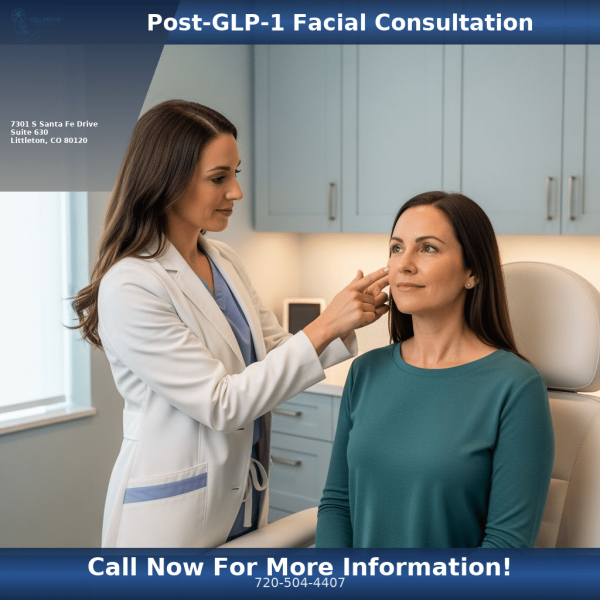
“Ozempic Face” Is Real: How a Littleton NP Treats Facial Volume Loss After GLP-1 Weight Loss
Key Takeaways:
- “Ozempic face” is the accelerated facial hollowing that occurs when GLP-1 medications cause rapid fat loss faster than skin can adapt — and it’s clinically treatable.
- A qualified provider evaluates three distinct categories — volume loss, skin laxity, and skin quality — before selecting between HA fillers, Hyperdilute Radiesse, or a combination approach.
- If you’re in Littleton or the Denver metro area and noticing changes in your face after GLP-1 therapy, a personalized assessment with a licensed NP is the clearest next step.
You lost the weight. You feel better in your body. But the face staring back in the mirror looks hollower, more tired, and older than it did before. What you’re seeing has a name — “Ozempic face” — and a clinical explanation. More importantly, it’s treatable, and you don’t have to choose between a healthier body and a face that reflects how you actually feel.
What “Ozempic Face” Actually Is
GLP-1 receptor agonists like semaglutide and tirzepatide work by suppressing appetite and slowing gastric emptying, which leads to significant caloric reduction and often rapid weight loss. That’s the intended effect. What’s less discussed is what happens to the face during this process.
Your face contains discrete fat compartments — layered pockets of fat that sit under the skin and above the muscle. These compartments give the cheeks their fullness, support the area beneath the eyes, and create the gentle contours around the nasolabial folds and jawline. When you lose weight quickly, those compartments deflate. Skin, which adapts more slowly than underlying fat, doesn’t always contract at the same pace. The result is a face that appears gaunt, sagging, or prematurely aged — even as the rest of the body looks slimmer.
This phenomenon isn’t unique to GLP-1 medications. Rapid weight loss from any cause can produce the same effect. What’s distinct about the current wave of GLP-1 use is the speed and magnitude of fat reduction, which can be dramatic enough to outpace the skin’s natural remodeling capacity. In 2026, this concern will become one of the most common questions aesthetic providers hear from patients who are genuinely proud of their progress and simply want their face to keep up.
How a Post-GLP-1 Face Is Evaluated
Not every face responds to GLP-1 weight loss the same way, which is why a thorough assessment matters before any treatment is recommended. Allison Page, NP-C, at Columbine Aesthetics evaluates patients across three categories.
The first is volume loss — the degree to which facial fat compartments have deflated. This shows up most visibly as hollow temples, a flattened mid-cheek, deepened tear troughs under the eyes, and a sharper, more skeletonized appearance overall.
The second category is skin laxity — how well the skin has contracted relative to the underlying fat loss. Some patients lose significant volume but retain good skin elasticity, so they primarily need volume restoration. Others present with jowling, a softened jawline definition, or loose skin along the lower face and neck, indicating compromised elasticity.
The third category is skin quality and texture — surface-level concerns like crepiness, fine lines, dullness, or a thinned quality to the skin itself. This often reflects reduced collagen density, a change that can be accelerated by rapid volume shifts.
Most patients present with a combination across all three categories. The proportion varies considerably, which is why the treatment plan is always individualized.
When HA Dermal Fillers Are the Right Choice
Hyaluronic acid (HA) fillers are the preferred tool when the primary complaint is volume loss — specifically in areas where deflated fat compartments have left visible hollowing.
Patients who present with flattened cheeks, sunken under-eye areas, deepened nasolabial folds, or lost lip support are typically good candidates for HA filler. These products integrate into the tissue and physically restore projection and fullness in the treated area. Because HA fillers are reversible with hyaluronidase, they also offer flexibility — particularly useful for patients who are still actively losing weight and whose faces may continue to change.
Placement is precise and anatomically intentional. Restoring the cheek, for example, often improves the appearance of the under-eye area at the same time because the underlying support structure lifts. The same logic applies to the nasolabial region — volume in the right location reduces the depth of a fold without overfilling it.
For patients who are stabilizing on their GLP-1 dose or who have recently completed their program, HA fillers offer immediate results that continue to integrate over the following two to three weeks.
When Hyperdilute Radiesse Is the Right Choice
When the evaluation reveals skin laxity or diminished skin quality — crepiness, loose skin along the jawline, a softened neck, or reduced elasticity throughout the lower face — Hyperdilute Radiesse offers a different mechanism of action.
Standard Radiesse is a calcium hydroxylapatite filler used for volume correction. Hyperdilute Radiesse is the same product mixed with a much larger volume of saline and lidocaine, which thins it to a consistency that spreads over larger surface areas. Instead of targeting discrete volume compartments, this technique is injected superficially across broader zones — the lower cheeks, jawline, neck, and décolletage — where it stimulates the body’s own collagen production over time.
The results are gradual. Most patients notice meaningful improvement in skin tightness and texture between six and twelve weeks post-treatment. The regenerative effect continues to build over several months, making Hyperdilute Radiesse particularly well-suited for patients who want to improve elasticity rather than simply add volume back.
This approach doesn’t feel like an add-on. For patients where laxity is the dominant concern, it’s simply the more appropriate tool.
Realistic Expectations and Treatment Timing
Timing matters significantly for patients actively using GLP-1 medications. If your weight is still changing month to month, it’s difficult to establish a stable facial baseline. Treating volume loss aggressively while the face is still shifting can lead to overcorrection or misaligned results.
Allison typically recommends a conservative approach for patients who are still losing weight — addressing the most functionally or aesthetically significant concerns first while planning for a more complete evaluation once the patient stabilizes. For patients who have plateaued on their GLP-1 program or are transitioning off, a fuller treatment plan becomes more reliable.
Realistic expectations include:
- HA filler results appear immediately and refine over two to three weeks
- Hyperdilute Radiesse results build gradually over six to twelve weeks
- Most patients benefit from one to two treatment sessions initially, spaced eight to twelve weeks apart
- Maintenance frequency depends on how stable the patient’s weight is and the individual collagen response
The goal is never to reverse your weight loss or make you look like a previous version of yourself. The goal is to make your face feel congruent with the healthier body you’ve worked to achieve. That’s a meaningful and realistic outcome — and one that’s well within reach with the right assessment and the right tools.
Sources
1. Mechanism of GLP-1 receptor agonists (semaglutide, tirzepatide) — U.S. Food and Drug Administration (FDA): https://www.fda.gov/drugs/postmarket-drug-safety-information-patients-and-providers/medications-containing-semaglutide-marketed-type-2-diabetes-or-weight-loss
2. Facial fat compartments and anatomical structure — Wikipedia overview of facial anatomy: https://en.wikipedia.org/wiki/Face
3. Hyaluronic acid fillers — Wikipedia: https://en.wikipedia.org/wiki/Hyaluronic_acid
4. Calcium hydroxylapatite (Radiesse) — Wikipedia: https://en.wikipedia.org/wiki/Calcium_hydroxylapatite
Frequently Asked Questions
Why Trust Columbine Aesthetics
At Columbine Aesthetics, we believe your aesthetic journey should be as unique as you are. Led by Allison Page, NP-C, our highly skilled Nurse Practitioner with over 20 years of healthcare experience, we combine medical expertise with an artistic eye to deliver natural, beautiful results that enhance — not alter — your appearance.
We specialize in helping clients make informed, confident decisions about treatments such as Dysport® and Botox®. While both smooth fine lines and soften wrinkles, they work in slightly different ways:
- Dysport® offers a quick onset and diffuses more easily across larger treatment areas, making it ideal for broader expression lines.
- Botox® provides exceptional precision, perfect for targeted wrinkle reduction and refined definition.
During your consultation, we’ll take the time to understand your unique goals, explain the subtle differences between options, and design a treatment plan that’s tailored to your desired outcome. Our mission is to ensure you feel comfortable, informed, and excited about your results from start to finish.
In addition to neuromodulators, our comprehensive medical spa menu includes:
- Botox® and Xeomin® injections for wrinkle prevention and correction
- Dermal fillers with hyaluronic acid for restoring youthful volume
- PCA Skin® chemical peels to smooth texture and brighten skin tone
- Microneedling with AnteAGE® growth factors for powerful collagen stimulation
Every treatment is performed with precision and care, ensuring you achieve a refreshed, natural look — never “overdone.”
Serving Littleton, Denver, and surrounding Colorado communities, Columbine Aesthetics is recognized for its client-first approach, rigorous safety standards, and dedication to ongoing education in the latest aesthetic techniques. Whether you want to prevent early signs of aging, rejuvenate your skin, or enjoy a comprehensive facial enhancement plan, our warm and professional environment makes your journey enjoyable and rewarding.
Ready to look and feel your best? Contact Columbine Aesthetics Botox and Medspa in Littleton, CO, today to schedule your personalized consultation and discover why clients trust us for expertise, artistry, and exceptional care.


